
Centre for Neurorehabilitation, Ageing and Balance Research
The Centre for Neurorehabilitation, Ageing and Balance Research conducts research to investigate changes in impairments, activities, and participation, particularly relating to balance and gait, that occur with age, pathology or that are acquired through injury.
Client-centred focus areas of the team include:
- Older adults (healthy, fallers)
- People with neurological disorders such as stroke, Parkinson’s Disease and Multiple Sclerosis
- Adults with metabolic disease (e.g. diabetes) and musculoskeletal disorders (hip osteoarthritis, neck pain
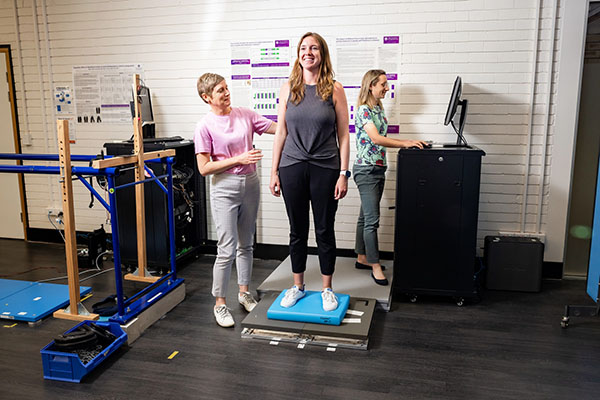
Losing touch: Exploring the neurophysiological effects of bionic sensory insole technology for balance rehabilitation.
The aim of this project is to engineer a state-of-the-art shoe insole, designed to stimulate foot skin sensors, to improve how the muscles and nerves work to keep the body upright. Through patient testing of the insole technology, the project will generate knowledge to develop an efficient balance rehabilitation device for people with neuropathy.
Find out more about the project
Capturing motion: classifying movement with wearable sensors in healthy adults, people with Parkinson’s disease and acquired brain injury – such as stroke.
Wearable sensors can capture common repetitive movements like walking, but cannot identify other functional movements important in recovery of daily life – such as reaching. The aim of this project is to capture common functional tasks (such as reaching, standing up) in a variety of adults in a once-off data collection session. This will enable the team to develop and evaluate accurate algorithms to detect and classify functional body positions and movements which will ultimately contribute to more timely and effective clinical management and rehabilitation. For more detail contact nabresearch@uq.edu.au.
ULTECH: Using technology to capture quality of movement and use of the upper limb after stroke.
After stroke, recovery of arm movement can be slow and difficult to measure, making it difficult for stroke survivors and the therapists who work them to see the impact of their treatment. The aim of this project is to improve the way we assess recovery of arm movement after stroke, so that small improvements can be measured.
A physiotherapy group exercise and self management program to improve physical activity in people with Parkinson’s disease: a randomised controlled trial.
Participating in physical activity is improves function and slows decline in people with Parkinson’s disease. The challenge is getting going and keeping going with exercise. The aim of this project is to determine if a 12-session program of physiotherapy-led group physical activity and self management more effective than usual care in people with mild-moderate Parkinson’s disease in improving daily step count, gait and health-related quality of life? Funded by Wesley Medical Research – Neurology Research grant. For more detail contact: nabresearch@uq.edu.au
To access study materials, please complete the online access form.
For full details on the study design, see the publised protocol in Trials: Brauer et al. 2024 view the publication (PDF, 1.1 MB)
UPLIFT: A Phase lla multicentre umbrella trial of integrated UPper limb and Language Impairment and Functional Training (UPLIFT) after stroke
1 in 6 people living with stroke have difficulty with both arm and communication functions. The purpose of this trial is to test a new intensive rehabilitation program that trains arm movement and communication together. The UPLIFT trial is a multicentre research project with therapy hubs located in Brisbane, Townsville, Melbourne, Perth and Adelaide.
RITA – Rehabilitation Innovation and Technology Assessment service.
This project aims to enhance rehabilitation treatment and support for individuals affected by brain or spinal cord injury. Specifically, the project will investigate the
impact of technology-aided movement practice, facilitated by interprofessional teams including rehabilitation engineering, occupational therapy and physiotherapy, on recovery outcomes during inpatient rehabilitation. Second, we aim to identify rehabilitation technology needs during hospitalization to improve discharge readiness and further promote post-discharge recovery. The RITA service is a multicentre project with sites spanning spinal cord, brain injury and stroke rehabilitation at the PAH and STARS Hospitals in Brisbane, funded by MAIC.
Can brain stimulation offset the effects of sleep deprivation?
Sleep deprivation is associated with dramatic impairment in cognitive performance. This research, funded by the US Special Operations Command, is using non-invasive brain stimulation to mimic sleep-related brain rhythms. The study is also investigating whether this form of brain stimulation can drive glymphatic flow within the brain. The findings of this research may provide insights into how the detrimental effects of sleep deprivation can be offset with brain stimulation.
The tACS challenge
Transcranial Alternating Current Stimulation (tACS) is a form of non-invasive brain stimulation that can entrain physiologically-relevant neural oscillations in the brain. The laboratory is part of a global collaborative seeking to better understand the neural effects of tACS. The study will use a variety of cognitive tasks, brain stimulation and brain imaging to investigate the effects of tACS.
VIBRANT
Three in five older adults aged over 60 have a hearing loss and the risk of falling for older adults is higher if they have a hearing loss. Researchers at The University of Queensland are conducting a study that will test if a device that gives feedback on body position can improve balance and stability.
Access to Physiotherapy for patients with Parkinson’s Disease attending the Royal Brisbane and Women’s Hospital Movement Disorders Clinic
Physiotherapy assessment and intervention is critical for maintaining physical function and reducing the risk of falls for people with Parkinson’s disease (PD). It is unclear if individuals with PD who are clients of the Royal Brisbane and Women’s Hospital movement disorders clinic, are accessing sufficient, appropriate, and timely physiotherapy. The aims of this study were to determine rates of referral to, and uptake of, physiotherapy services for individuals with PD, and to identify barriers and enablers to accessing physiotherapy services for individuals with PD. Results of this project will guide the development of strategies to improve referral to and uptake of physiotherapy for clients of the RBWH movement disorders clinic.
Project led by Beth Cunningham with investigators Lindsay Hepnar, and Dr Peter Window (Physiotherapy dept RBWH)
A/Prof John O’Sullivan, Dr Rob Adam, Dr Micheal Katz, Dr Shayani Upadhyay and Dr Jasmine De Oliveira (Neurology Department, Royal Brisbane and Women’s Hospital), Professor Sandra Brauer and Dr Robyn Lamont
Centre Co-Directors:
Professor Sandra Brauer, School of Health and Rehabilitation Sciences
Professor Brauer is the Director of the Centre for Neurorehabilitation, Ageing and Balance Research whose research aims to improve function and participation in people with neurological disorders, in particular stroke and Parkinson’s disease, with physical activity, upper limb function and technology key areas of focus.
Associate Professor Anna Hatton, School of Health and Rehabilitation Sciences
Associate Professor Hatton is Co-Director of the Centre for Neurorehabilitation, Ageing and Balance Research whose focus is to understand the role of sensory information for balance and gait in healthy and pathological groups, including diabetes and multiple sclerosis. In partnership with industry, the team seeks to develop innovative smart wearables, such as footwear devices, to enhance active living in a wide range of populations.
UQ Academic Staff/ Postdoctoral Researchers
- Dr Nicholas Bland, School of Health and Rehabilitation Sciences
- Associate Professor Sjaan Gomersall, School of Health and Rehabilitation Sciences/School of Human Movement and Nutrition Sciences
- Dr Robyn Lamont, School of Health and Rehabilitation Sciences
- Dr Christopher Mackay, School of Health and Rehabilitation Sciences / Princess Alexandra Hospital
- Dr Niru Mahendran, SHRS/Surgical Treatment and Rehabilitation Service (STARS)
- Associate Professor Martin Sale, School of Health and Rehabilitation Sciences
- Dr Alejandro Melendez-Calderon, School of Electrical Engineering and Computer Science
- Dr Neelam Nayak, Southern Queensland Rural Health
- Dr Wolbert van den Hoorn, School of Health and Rehabilitation Sciences
- Dr Katrina Williams, School of Health and Rehabilitation Sciences
- Dr Emily McCann, School of Health and Rehabilitation Sciences
- Mrs Estelle Corr, School of Health and Rehabilitation Sciences
Research assistants
- Woon Ki Chew
- Dr Asher Geffen
- Rebecca Gorwyn
- Irene Huang
- Jonathan Jennings
- Katrina Kemp
- Dr Shamini Kosgallana
- Joey Mabin
- Chantelle Nguyen
- Benjamin Ong
- Emma Reiter
- Andrea Saverymuthapulle
- Aiden Tso
Physiotherapy clinicians
HDR Students
| Candidate | Degree | Supervision | Project Title/Description |
|---|---|---|---|
| Eugene Cho | PhD | Associate Professor Martin Sale QBI | The cognitive and neural bases of creative thought |
| Auwal Hassan | PhD | Associate Professor Martin Sale Child Health Research Centre | Investigating the use of non-invasive brain |
| Dan Innes | PhD | Dr Katrina Williams | Implementing visual rehabilitation for stroke and brain injury survivors |
| Cristina Levy | PhD | Professor Sandra Brauer | Early biomarkers of upper limb function and mobility recovery post stroke |
| Derong Eric Li | PhD | Associate Professor Anna Hatton | Development of a Novel Assessment Battery through Comprehensive Skills Analysis and Injury Surveillance in Unarmed Combat Sports Athletes |
| Karina Pell | PhD | Associate Professor Anna Hatton Dr Wolbert van den Hoorn | Bionic Sensory Insole Technology for Optimising Sport Performance and Injury Prevention in Netball |
| Upendranatha Potturi | PhD | Dr Niru Mahendran, Professor Sandra Brauer, Dr Bernadine Teng, Prof Suzanne Kuys, Dr Melanie Hoyle | Helping people with stroke return to meaningful and healthy lives early after stroke |
| Andrea Saverymuthapulle | PhD | Dr Niru Mahendran, Professor Sandra Brauer | Understanding challenge in the rehabilitation of walking after stroke |
| Megan Trotman | PhD | Associate Professor Anna Hatton | Exploring the neurophysiological effects of vibrotexture shoe insoles for balance rehabilitation in adults with foot sensory loss. |
| Stephen West-Newman | PhD | Associate Professor Martin Sale | Exploring the experiences of clinical based learning and transition to clinical practice for physiotherapy students from a culturally and linguistically diverse (CALD) background with a view to informing better student, university and clinical placement practices |
Honorary Appointments
- Associate Prof Kate Hayward, Honorary Research Fellow, University of Melbourne
- Dr Sonia Brownsett, Speech Pathology, Queensland University of Technology (QUT)
- Prof Sivakumar Balasubramanian, Christian Medical College Vellore, India
- Dr Bernadine Teng, Singapore Institute of Technology, Singapore
International Collaborators
- Professor James Brownjohn, University of Exeter, UK
- Professor Richard Carson, School of Psychology & Trinity College Institute of Neuroscience, Trinity College, Dublin, Ireland
- Dr Thomas Cattagni, University of Nantes, France
- Dr Lay Fong Chin, Tan Tok Seng Hospital, Singapore
- Professor François Hug, University of Côte d'Azur, France
- Dr Marina Mahafza, Al-Ahliyya Amman University, Jordan
- Dr Ingrid Rosbergen, Leiden University of Applied Sciences, Netherlands
- Associate Professor Nada Signal, Auckland University of Technology
- Dr Gavin Wylie, Dundee University, UK
National Collaborators
- Emeritus Professor Louise Ada, School of Physiotherapy, University of Sydney
- Dr Tahlia Alsop, School of Allied Health, Sport and Social Work, Griffith University
- Associate Professor Ruth Barker, School of Public Health, Tropical Medicine & Rehab Sci, James Cook University
- Associate Professor Ingvars Birzneiks, University of New South Wales, Sydney
- Dr Daniel Boulton, Neuroscience Research Australia, Sydney
- Professor Tracy Comans, School of Population Health, Griffith University
- Dr Rohan Grimley, Neurologist, Research Director of Sunshine Coast University Hospital
- Dr Sheree Hurn, Podiatry, Queensland University of Technology, Brisbane
- Professor Graham Kerr, School of Exercise & Nutrition Science, The Queensland University of Technology
- Professor Suzanne Kuys, School of Physiotherapy, Australian Catholic University
- Dr Jayishni Maharaj, Griffith University, Gold Coast
- Professor Steven McPhail- Australian Centre for Health Services Innovation, The Queensland University of Technology
- Dr Camila Shirota, Disability and Rehabilitation, Griffith University, Queensland Health
- Dr Paul Varghese, Director GARU, Princess Alexandra Hospital, Brisbane
Clinical Collaborators
- Amir Asadi, Rehabilitation Engineering STARS
- Lucas Cardoso, Rehabilitation Engineering STARS
- Beth Cunningham, Physiotherapy, RBWH
- Jacinta Foster, Physiotherapy, Logan Hospital
- Ben Hay, Physiotherapy, STARS
- Lindsay Hepnar, Physiotherapy, RBWH
- Haylee Kajewski, Physiotherapy, STARS
- Eloise Labrom, Occupational Therapy STARS
- Tamsin Mahoney, Occupational Therapy, STARS
- Jacqui Mitchell, Physiotherapy, PAH
- Leanne Passier, GARU Physiotherapy, PAH
- Samantha Robinson, Dietetics SCUH / Queensland Digital Health Centre
- Raj Singh, Physiotherapy, STARS
- Gio Tornatore, Occupational Therapy STARS
The University of Queensland
School of Health and Rehabilitation Sciences Collaborators
- Dr Lisa Anemaat – Speech Pathology
- Professor David Copland- Speech Pathology
- Professor Piers Dawes – Audiology
- Dr Emmah Doig – Occupational Therapy
- Professor Jenny Fleming – Occupational Therapy
- Dr Hannah Gullo- Occupational Therapy
- Emeritus Professor Louise Hickson – Audiology
- Professor Paul Hodges- Physiotherapy
- Dr Melanie Hoyle – Occupational Therapy
- Associate Professor Asad Khan – School Statistician
- Associate Professor Jacki Liddle – Occupational Therapy
- Dr Megan Ross, Physiotherapy
- Professor Trevor Russell – Physiotherapy
- Dr Dion Scott – Principal Scientific Officer
- Associate Professor Michelle Smith - Physiotherapy
- Dr Barbra Timmer – Audiology
- Dr Julia Treleaven- Physiotherapy
- Emeritus Professor Bill Vicenzino - Physiotherapy
- Associate Professor Wayne Wilson – Audiology
Inter-School/Faculty Collaborators
- Professor Andrew Burton Jones, School of Business
- Professor Andy Cresswell, School of Human Movement and Nutrition Sciences
- Professor Genevieve Healy, School of Human Movement and Nutrition Sciences
- Dr David Lloyd, Queensland Brain Institute
- Associate Professor John O’Sullivan, School of Medicine
- Associate Professor Kylie Tucker, School of Biomedical Sciences
- Professor Sean Tweedy, School of Human Movement and Nutrition Sciences
- Dr Liz Winkler, School of Human Movement and Nutrition Sciences
- Associate Professor Andrew Wong, UQ Centre for Clinical Research
Industry Partners
Enquiries
Centre for Neurorehabilitation, Ageing and Balance Research
School of Health and Rehabilitation Sciences
The University of Queensland
St Lucia, Qld, 4072